

What is Oral Immunotherapy (OIT)? A Plain-Language Guide for Australian Families
If your child has a peanut allergy, you've probably been told the same thing for years: avoid it completely. But medicine has moved on. Here's what oral immunotherapy actually involves, and what the evidence says.
The first time it happened, maybe it was a cracker at a friend's house. A smear of peanut butter on someone else's toast. A shared bag of mixed nuts. Within minutes: hives, a swelling lip, a terrified sprint to the car. If you have a child with peanut allergy, the fear of that moment, or something far worse, shapes almost everything. Where you go, what you pack, what you let them eat, who you trust.
For most Australian families living with food allergy, complete avoidance has been the only option. No treatment. No path forward. Just vigilance, forever.
That is changing. And the change is bigger than most families know.
“One of the biggest concerns for families living with peanut allergy is the fear of accidental exposure. This program has the potential to remove that burden”
What is Oral Immunotherapy?
Oral immunotherapy (OIT) is a medical treatment in which a person with a confirmed food allergy consumes gradually increasing amounts of their allergen, under strict medical supervision, with the goal of raising their body's tolerance threshold.
It is not a cure, and it does not work the same way for everyone. But for many children, it can mean the difference between anaphylaxis from a trace of hidden peanut and tolerating a significant dose without a severe reaction.
The core idea is deliberate, controlled exposure. Start very small, sometimes just a fraction of a milligram, and over weeks and months, work upward toward a maintenance dose that the child takes every day at home. ¹
ASCIA; the Australasian Society of Clinical Immunology and Allergy, the peak professional body for allergy specialists in Australia, describes OIT as involving "daily ingestion of the food(s) to which a person is known to be allergic, under medical guidance," with doses that are "initially small and gradually increased in an attempt to reach a target maintenance dose." ¹
That target maintenance dose is then taken daily, at home, for an extended period.
IMPORTANT DISTINCTION
ASCIA distinguishes between three possible outcomes:
desensitisation: a raised reaction threshold while on treatment,
sustained unresponsiveness: maintaining tolerance after stopping OIT for a period, and oral tolerance: eating the allergen freely, even after years of avoidance.
Current OIT methods reliably achieve desensitisation for many children. Sustained unresponsiveness occurs in a smaller proportion. Oral tolerance has not been demonstrated in published trials. OIT is not currently considered a cure. ¹
Why avoidance alone is harder than it sounds
The appeal of "just avoid peanuts" is its simplicity.
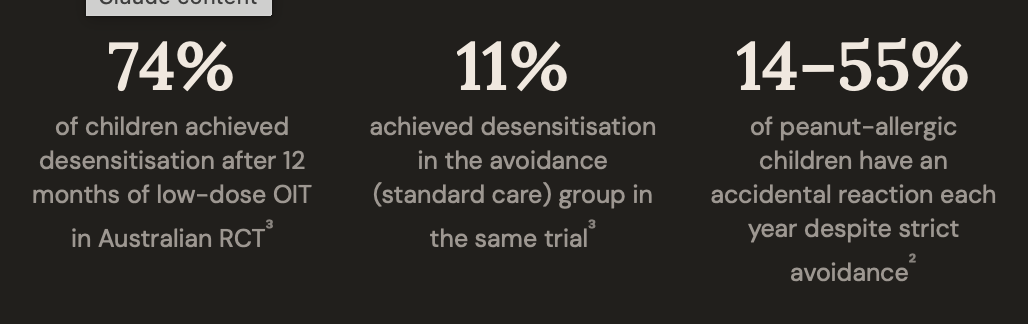
In practice, it is one of the most psychologically demanding things a family can sustain indefinitely. Research published in The Lancet found that accidental reactions to peanut occur in 14 to 55 percent of allergic children per year, despite families actively trying to avoid exposure. ²
The problem isn't carelessness. It's that peanut is everywhere, labelling is imperfect, and trace contamination in shared kitchens is essentially unavoidable over a lifetime.
The psychological weight is substantial and measurable. Studies consistently show that quality of life for families with food-allergic children is significantly impaired. Not just around food itself, but in social situations, travel, school, and daily decision-making. ³
This matters because OIT is sometimes presented as risky relative to avoidance. And which is true in a narrow sense (OIT does cause more reactions during treatment). But avoidance is not risk-free.
The hidden costs of avoidance such as social isolation, anxiety, accidental exposure, and the cumulative burden on families are real. Even if they don't show up in an adverse event log. ⁴
What does the evidence actually show?
This is the question that matters.
OIT has accumulated a substantial body of randomised controlled trial evidence over the past 15 years, and the picture is reasonably clear, though not uncomplicated.
ON DESENSITISATION
A 2022 systematic review and meta-analysis of allergen-specific immunotherapy trials, commissioned to inform updated international guidelines, found with high certainty that peanut OIT is effective at inducing desensitisation. ¹
The landmark Cambridge STOP II randomised controlled trial, published in The Lancet, found that after six months of peanut OIT in children aged 7–16, 84–91 percent of participants could tolerate the equivalent of five peanuts per day, alongside a significant improvement in quality of life. ²
More recently, an Australian randomised controlled trial, published in Clinical & Experimental Allergyin 2025, found that 12 months of low-dose peanut OIT was effective at inducing desensitisation in 74% of children receiving OIT, compared with just 11% of children in the avoidance group.
Crucially, the OIT group also reported significantly better quality of life than the avoidance group, with the improvement linked specifically to achieving desensitisation, not simply to being in the treatment arm. ³
ON SAFETY
OIT does carry real risk, and honest information about this matters. People on OIT have more allergic reactions overall than people avoiding their allergen because the treatment itself involves regular allergen exposure. ¹
The ASCIA position paper is explicit: the goal of OIT should be weighed against "possible side effects such as allergic reactions, including severe allergic reactions (anaphylaxis)." ¹
The good news is that in young children, the majority of reactions during home dosing are mild. The 2025 Australian trial reported that 79% of adverse events during home dosing were mild, and no epinephrine was used during home doses in that study. ³
However, serious adverse events including anaphylaxis do occur. This is not a zero-risk intervention, and it requires ongoing medical supervision throughout.
DO NOT ATTEMPT OIT AT HOME UNSUPERVISED
Australia's National Allergy Centre of Excellence is direct on this: families are urged not to try OIT at home without medical supervision. The treatment follows a carefully planned dosing schedule under strict allergist oversight. Attempting it independently risks serious harm. ⁵
ON QUALITY OF LIFE: AND WHY IT MATTERS FOR THIS DECISION
One important nuance in the OIT literature is that quality of life improvements are not guaranteed simply from undergoing treatment. They appear most strongly in families whose children successfully reach desensitisation.
The Australian 2025 RCT found that the significant difference in quality of life between the OIT and avoidance groups only emerged after the end-of-treatment food challenge was completed. ³ This is worth knowing: the process of OIT itself involves a period of heightened vigilance and more frequent reactions before those benefits are realised.
The ASCIA graduated exposure protocol. How it actually works
The ASCIA protocol is not a single rigid procedure; it is a framework supervised by a clinical immunology and allergy specialist, tailored to the individual child. Most OIT programs follow the same general structure:
Confirmation and baseline testing
The child's peanut allergy is confirmed through skin prick testing, specific IgE blood tests, and usually a supervised oral food challenge. A baseline reaction threshold is established before treatment begins.
Initiation phase (clinic-supervised)
The very first doses are given in a clinical setting, typically a hospital allergy clinic, where the child is monitored for a period after each dose. Doses start extremely small, sometimes fractions of a milligram of peanut protein.
Build-up / escalation phase
Doses are incrementally increased over weeks to months. Updosing usually happens in clinic, with new higher doses given under observation before continuing at home. Daily home dosing continues between clinic visits. This is the phase with the highest rate of reactions.
Maintenance phase
Once the target dose is reached, the child takes it daily at home indefinitely. The allergen must continue to be consumed regularly. Stopping OIT after desensitisation is achieved can lead to loss of protection.
End-of-treatment challenge (remission evaluation)
After a defined period (often 12+ months at maintenance), some protocols include an oral food challenge to assess whether sustained unresponsiveness has been achieved. Meaning whether tolerance persists after a period of not taking the maintenance dose.
Throughout the entire protocol, families carry an adrenaline autoinjector (such as an EpiPen) and hold an ASCIA Anaphylaxis Action Plan. This doesn't change during OIT. ¹
There are also important cofactors that increase reaction risk at home dosing: exercise within two hours of a dose, illness, sleep deprivation, and, in some people, taking a dose after a large meal. Protocols generally include guidance for families to hold or reduce doses when cofactors are present. ¹
Who is OIT for? Age, eligibility, and what makes a family a candidate
OIT is not appropriate for everyone, and the decision involves careful shared decision-making between the family and the treating allergist. ASCIA is explicit that it is essential to weigh potential benefits against "safety issues and impact on quality of life, including the burden of undergoing OIT." ¹
In terms of age: there is high-quality evidence for peanut OIT in children aged 4–17 years. ⁶
There is also growing evidence specifically for younger children, with the recent ADAPT OIT Program in Australia. Launched in 2024 across 10 paediatric hospitals, is offering OIT to babies under 12 months who have been diagnosed with peanut allergy. ⁵
Research suggests that beginning treatment at a younger age may be associated with better long-term outcomes. ¹
For older children and adults outside hospital programs, OIT may be available through private allergy clinics offering evidence-based protocols. It is not available as a TGA-registered commercial product in Australia. There is currently no approved peanut OIT product on the Australian market. So it is offered using food products (such as peanut flour or powder) under allergist supervision. ¹
GOOD CANDIDATES FOR OIT TEND TO INCLUDE CHILDREN WHO
• Have a confirmed IgE-mediated peanut allergy (not just sensitisation)
• Are otherwise healthy and do not have poorly controlled asthma or eosinophilic oesophagitis
• Have a family with the capacity to commit to daily dosing and regular clinic visits over 1–2+ years
• Have an allergist willing to discuss and supervise the process
This is a general guide only. Individual suitability should always be assessed by a clinical immunology/allergy specialist.
What Australia has that the rest of the world doesn't
Australia has the highest rate of childhood food allergy in the world. ⁵ That unenviable distinction comes with at least one advantage: a concentration of world-class research and clinical infrastructure in this space that few countries can match.
In mid-2024, Australia became the first country globally to introduce a nationwide peanut OIT program into mainstream care outside of a clinical trial. ⁵
The ADAPT OIT Program stands for Allergy Development to an Accelerated Pathway to Tolerance. And is run through ten paediatric hospitals across five states, coordinated by the National Allergy Centre of Excellence (NACE) at Murdoch Children's Research Institute (MCRI). ⁵
The program is currently available to babies under 12 months who are diagnosed with peanut allergy and seen by an allergist at a participating hospital. ⁵ If the evaluation shows it is safe and effective, the intention is to expand to more hospitals and private allergy clinics, including in regional areas. ⁵
For older children not eligible for ADAPT, OIT may still be available through private allergy clinics. But access is uneven, and it requires active engagement with a specialist who offers and supervises it.
How to find a supervising allergist in Australia
The starting point is your GP. If your child has a confirmed or suspected peanut allergy, your GP can refer to a clinical immunology and allergy specialist. ASCIA maintains a searchable specialist directory at allergy.org.au.
When you see an allergist, it is reasonable to ask directly whether they offer OIT and what protocol they follow. Not all allergists offer it, and that's legitimate, given that it requires significant infrastructure and clinical support.
Shared decision-making means you should come to the appointment knowing the questions to ask, and the allergist should walk you through the full picture: what it involves, what it costs (OIT in private clinics is typically out-of-pocket and can be significant), what the likely timeline is, and what the realistic outcomes look like for your child.
If your baby is under 12 months and has received a peanut allergy diagnosis, ask your GP specifically about the ADAPT OIT Program and whether a referral to a participating hospital is possible. ⁵
What the commitment looks like, honestly
This is the part most articles gloss over, and families deserve to know it clearly. OIT is not a short course of treatment. It requires:
Daily home dosing. Every single day, at a consistent time, the child takes their dose. Most protocols recommend avoiding vigorous exercise within two hours after dosing, so families often anchor dosing to a quiet time, usually after school, before bed. Missed doses or irregular timing can affect safety at the next dose.
Regular clinic visits. Especially during the build-up phase, updosing happens in clinic under observation. This means appointments, often monthly or more frequently in early phases, that require a parent to be present and the child to be observed for a defined period after each dose increment.
Ongoing vigilance, redefined. OIT doesn't eliminate the need for an EpiPen. Families continue to carry adrenaline autoinjectors and hold an ASCIA Action Plan throughout. What changes if desensitisation is achieved, is the margin for error. A trace exposure that would previously have caused anaphylaxis may no longer do so. The psychological relief that comes from that shift is, for many families, transformative.
A time horizon of years, not months. Building to a maintenance dose typically takes many months. Maintaining that dose is ongoing. And if your goal is sustained unresponsiveness: the ability to stop daily dosing while retaining protection, that requires additional time and a formal challenge to assess.
“OIT treatment takes time and this program requires a long-term commitment from families to give their child daily doses of peanut powder at home along with regular visits to their hospital allergy clinic.”
-
No. ASCIA is clear that current food OIT methods are not a cure for food allergy. Desensitisation means the reaction threshold is raised while the child is actively consuming the allergen. If dosing stops, that protection may be lost. Some children achieve sustained unresponsiveness. This means protection persists after stopping for a defined period, but this is not guaranteed, and even those children typically still need to carry an adrenaline autoinjector. ¹
-
Almost certainly yes, to some degree. OIT involves deliberate allergen exposure, and most children experience some reactions. Typically mild (oral itch, hives, mild gastrointestinal symptoms), particularly during the build-up phase and when cofactors are present.
Severe reactions requiring epinephrine are less common but do occur. The program is structured specifically to manage and minimise this risk. ¹,³
-
It depends on the outcome. Children who reach desensitisation can generally tolerate the allergen at or below their achieved threshold, which may be several peanuts' worth of protein. That does not mean freely eating peanut butter sandwiches without thought, and they still need to carry their EpiPen.
Some children achieve sustained unresponsiveness and can eat peanuts more freely after stopping OIT, but this is not the expected outcome for everyone. ¹
-
There is currently no MBS item number for OIT in Australia (ASCIA has an application in progress as of 2025). This means the cost falls largely to families in private settings.
The ADAPT OIT Program through participating hospitals is free for eligible children. In private clinics, total OIT costs can be substantial. Ask about fees explicitly during your initial consultation.
-
Multi-food OIT is being studied, and some clinics do offer it for multiple allergens simultaneously. It is more complex and the evidence base is less established than for single-allergen OIT.
Discuss this specifically with an allergist. It may still be appropriate depending on your child's allergy profile.
-
No. There is high-quality evidence for OIT in children aged 4–17. Starting earlier appears to be associated with better outcomes as younger children may be more likely to achieve sustained unresponsiveness. But this does not mean older children cannot benefit from desensitisation. ¹,⁶
Medical disclaimer: This article is a clinical education resource and does not constitute medical advice. All information about OIT protocols, eligibility, and outcomes should be discussed with a clinical immunology and allergy specialist registered in Australia. Decisions about OIT involve individualised assessment of benefits, risks, and family circumstances.
SOURCES
ASCIA Position Paper: Oral Immunotherapy for Food Allergy. Australasian Society of Clinical Immunology and Allergy (ASCIA), updated July 2024. allergy.org.au
Anagnostou K et al. Assessing the efficacy of oral immunotherapy for the desensitisation of peanut allergy in children (STOP II): a phase 2 randomised controlled trial. The Lancet.2014;383(9925):1297–1304. thelancet.com
O'Sullivan M et al. Pragmatic low-dose oral immunotherapy for preschool children with peanut allergy: a randomised controlled trial. Clinical & Experimental Allergy. 2025. onlinelibrary.wiley.com
Peters RL et al. The prevalence of IgE-mediated food allergy and other allergic diseases in the first 10 years: the population-based, longitudinal HealthNuts study. Journal of Allergy and Clinical Immunology: In Practice. 2024;12(7):1819–1830. DOI: 10.1016/j.jaip.2024.03.015
National Allergy Centre of Excellence. ADAPT OIT Program FAQ. nace.org.au; ASCIA news update, July 2024. allergy.org.au
Early Peanut Immunotherapy in Children (EPIC) trial protocol. PMC.pmc.ncbi.nlm.nih.gov